



Why Installing GFCI Outlet Protection Can Save Your Life
Installing GFCI outlet protection is one of the most important electrical safety upgrades you can make in your home. Here’s what you need to know:
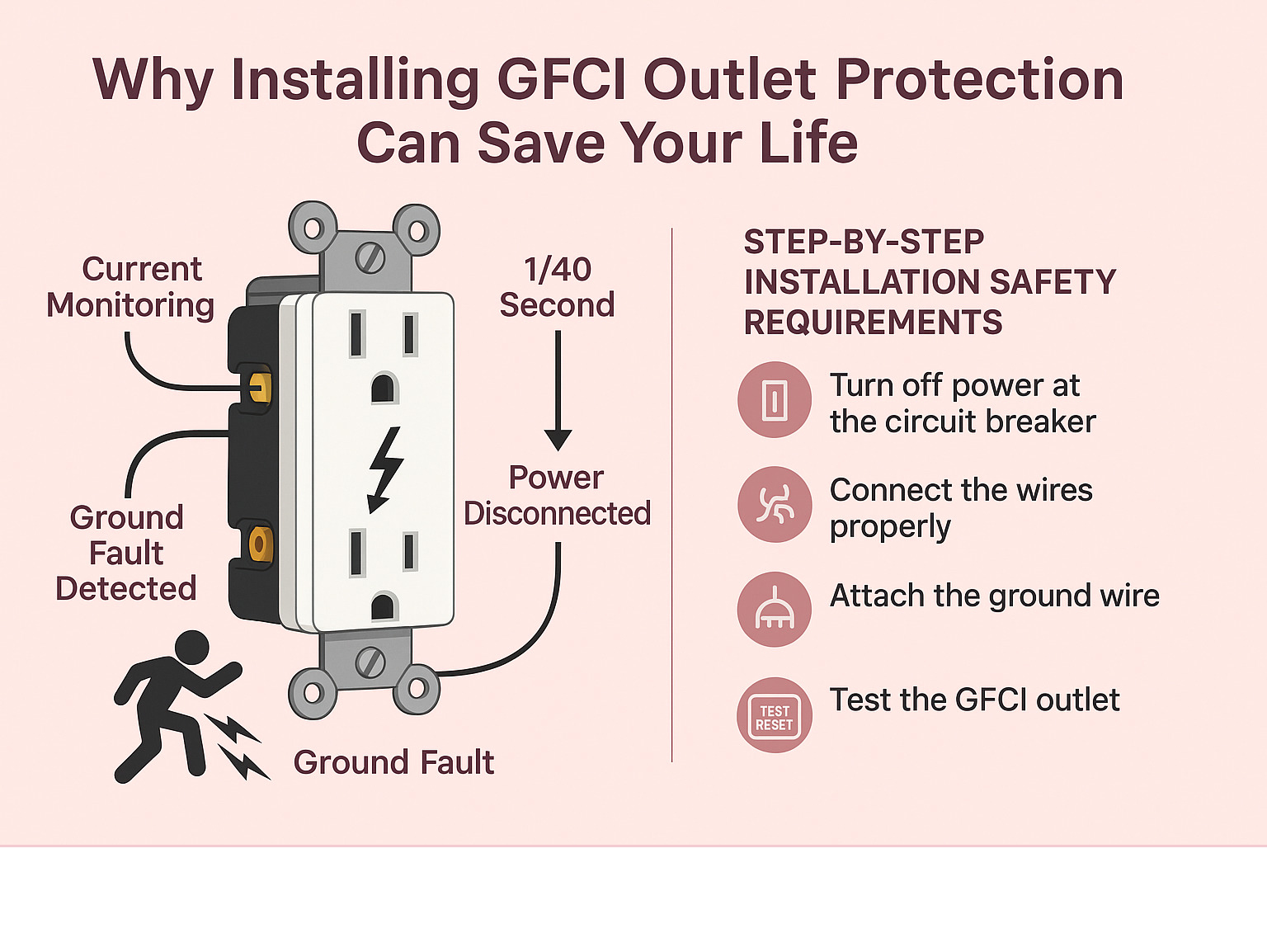
Key Steps for Installing GFCI Outlet:
- Turn off power at the circuit breaker and verify with a voltage tester
- Remove old outlet and identify LINE (incoming power) vs LOAD (downstream) wires
- Connect wires – black to brass LINE terminal, white to silver LINE terminal
- Attach ground wire to green screw on the GFCI outlet
- Test the outlet by pressing TEST button, then RESET button
- Label downstream outlets as “GFCI Protected” if applicable
A Ground Fault Circuit Interrupter (GFCI) outlet monitors electrical current and shuts off power in milliseconds when it detects dangerous ground faults. This instant response prevents electrical shock and electrocution.
The numbers tell the story: Home electrical fires account for an estimated 51,000 incidents each year, resulting in nearly 500 fatalities. Since the 1970s, GFCI outlets have saved thousands of lives and helped cut home electrocutions in half.
GFCI outlets are mandatory by code in bathrooms, kitchens, outdoor areas, garages, unfinished basements, and anywhere electricity meets water. The National Electrical Code requires this protection because 47% of current electrocutions could be prevented with proper GFCI installation.
While the concept seems straightforward, installing GFCI outlet protection involves critical safety steps and code requirements that can be dangerous if done incorrectly. LINE and LOAD terminal confusion, improper grounding, and electrical box capacity issues are common mistakes that can leave your family unprotected.
I’m Dan Walsh, and through years of managing home electrical services, I’ve seen how proper GFCI outlet installation saves lives while poor installation creates deadly hazards. My experience with residential electrical safety has shown me that professional installation ensures code compliance and family protection.
Installing gfci outlet further reading:
GFCI Outlet Basics & Why Your Home Needs Them
When installing GFCI outlet protection, you’re essentially putting a lightning-fast guardian between your family and electrical danger. A ground fault happens when electricity decides to take a shortcut—usually through water or, worse yet, through a person’s body. That’s when a GFCI outlet becomes your lifesaver.
Here’s what makes these outlets so remarkable: they monitor electrical current flow between hot and neutral wires with incredible precision. The moment they detect even a tiny imbalance—we’re talking milliseconds—they instantly cut power. It’s like having a security guard who never blinks, never takes a break, and reacts faster than you can even feel the shock.
The numbers from the Electrical Safety Foundation International tell a sobering story. Approximately 30,000 non-fatal electrical shocks from outlets happen every year in the United States. Even more concerning? Half of all U.S. homes were built before GFCI outlets existed, leaving millions of families vulnerable to completely preventable electrical hazards.
The National Electrical Code doesn’t mess around when it comes to GFCI requirements. Your home needs this protection in bathrooms, kitchens within 6 feet of sinks, outdoor areas, garages, unfinished basements, crawl spaces, utility rooms, and laundry areas. These are the spots where electricity and moisture are most likely to cross paths—and where accidents happen.
Here’s something most homeowners forget: monthly testing keeps your family safe. Simply press the TEST button on each GFCI outlet to make sure it trips, then press RESET to restore power. This quick check ensures your protection is working when you need it most.
Latest research on GFCI protection confirms that proper installation and regular maintenance dramatically reduce electrical injury rates in homes.
How a GFCI Works in Plain English
Picture a GFCI outlet as an electrical detective that never stops investigating. Inside this smart device, a sensor coil constantly compares the current flowing out through the hot wire with the current returning through the neutral wire. Under normal circumstances, these amounts should match perfectly.
But when trouble strikes—like when that hair dryer slips into a sink full of water—some electricity escapes through the water instead of following its proper path back through the neutral wire. The GFCI’s sensor catches this mismatch instantly and triggers an automatic disconnect in just 1/40th of a second.
Modern GFCI outlets come equipped with SafeLock technology that performs self-checks every few seconds. If the internal protection circuits fail, the entire device shuts down rather than giving you false confidence.
Hidden Benefits Beyond Shock Prevention
While preventing electrocution is obviously the main event, GFCI outlets deliver several bonus benefits that often surprise homeowners. Fire reduction tops this list—the same ground faults that cause dangerous shocks can also create electrical arcing that ignites nearby materials.
Your expensive appliances get protection too. When electrical current finds unintended escape routes, it can fry sensitive electronics and damage motor-driven appliances. The GFCI’s instant shutdown prevents this costly destruction before it starts.
Many homeowners find that installing GFCI outlets can lower insurance premiums. Insurance companies recognize that homes with proper electrical safety features pose fewer risks, and some reward this responsible maintenance with reduced rates.
Code compliance becomes especially important if you live in St. Charles, O’Fallon, or surrounding areas where electrical inspections are required during home sales or renovations. Having proper GFCI protection throughout your home demonstrates responsible ownership and can prevent expensive upgrade demands during real estate transactions.
Installing GFCI Outlet Safely: Step-by-Step Overview
Installing GFCI outlet protection is serious business that demands respect for electricity’s power. The process starts with one non-negotiable rule: complete power verification. Never trust that flipping a breaker actually killed the power—electricity doesn’t forgive assumptions.
Professional electricians use a systematic approach that protects both the worker and the home. First comes power-off verification using both circuit breakers and multiple testing methods. A non-contact voltage tester provides the first check, followed by a multimeter for absolute confirmation.
The tools list for proper installation goes beyond what most homeowners have in their garage. Quality wire strippers, insulated screwdrivers, and professional-grade voltage testers aren’t just nice to have—they’re essential for safety. The wrong tool at the wrong moment can turn a simple outlet replacement into a dangerous situation.
Understanding line versus load connections separates successful installations from dangerous mistakes. LINE terminals receive power from your electrical panel, while LOAD terminals send protected power to other outlets downstream. Mix these up, and your GFCI becomes an expensive decoration that won’t protect anyone.
Ground wire connections require special attention, especially in older St. Charles and O’Fallon homes where electrical systems may have been updated over the decades. The green screw on your GFCI outlet needs a solid connection to a proper equipment ground to function correctly.
Box fill calculations ensure your electrical box can safely hold the larger GFCI device. These outlets are bulkier than standard receptacles, and cramming them into undersized boxes creates fire hazards.
Downstream protection is where GFCI outlets really shine. One properly installed GFCI can protect multiple standard outlets connected to its LOAD terminals. This means you can safeguard an entire bathroom or kitchen area with strategic placement.
The complexity of these requirements is why many homeowners choose professional installation. At AAA Home Services, our licensed electricians handle installing GFCI outlet projects throughout the Greater St. Louis area, ensuring code compliance and family safety.
For more comprehensive information about home electrical systems, check out our guide on Electrical House Wiring.
Installing GFCI Outlet: Tools & Materials Checklist
Professional installing GFCI outlet work requires specific tools that most homeowners don’t have sitting in their toolbox. The difference between amateur and professional results often comes down to having the right equipment for the job.
A non-contact voltage tester rated for household voltages is your first line of defense. These devices detect electrical fields around wires without requiring direct contact. However, they’re just the starting point—a digital multimeter provides the precise voltage readings that confirm complete power isolation.
Insulated screwdrivers with proper voltage ratings protect against accidental contact with live wires. Wire strippers designed for residential gauge wire ensure clean cuts that create solid connections.
A GFCI outlet tester with indicator lights verifies proper installation once the work is complete. These devices check that hot, neutral, and ground wires are connected correctly while testing the GFCI’s ability to trip and reset properly.
Personal protective equipment includes safety glasses, insulated gloves, and rubber-soled shoes. The GFCI outlet itself comes in 15-amp and 20-amp versions depending on your circuit requirements. Wire nuts and electrical tape complete the connection materials needed for safe installation.
Removing Old Receptacle & Identifying Line/Load
Safe removal starts with turning off the breaker and testing the outlet with a known working device like a lamp. But that’s just the beginning—professional electricians take additional steps to ensure complete safety.
Photo documentation before disconnecting anything prevents costly mistakes during reassembly. Take clear pictures showing wire colors, positions, and existing connections.
Wire labeling during removal eliminates confusion between LINE and LOAD wires. Use masking tape to mark incoming power wires and outgoing wires that feed other outlets.
The voltage test must be thorough and methodical. Test between hot and neutral, hot and ground, and neutral and ground to verify complete power isolation. Any voltage reading indicates live wires that need immediate attention.
Wiring, Mounting & Grounding the New Unit
Proper wire connections form the foundation of GFCI safety. The black wire connects to the brass LINE terminal, while the white wire connects to the silver LINE terminal. These connections must be tight and secure—loose connections create heat, arcing, and potential fire hazards.
Ground wire attachment to the green screw requires special attention. In electrical boxes with multiple ground wires, professional electricians create a pigtail ground connection using a wire nut to join all grounds together, then connect the pigtail to the GFCI’s green screw.
Wire stripping length matters more than most people realize. Strip insulation to the exact length specified on the GFCI device—typically 3/4 inch. Too little stripped wire creates poor connections, while too much creates shock hazards from exposed copper.
Torque check procedures ensure connections remain secure over time. Professional electricians perform the “tug test” after making connections, gently pulling each wire to confirm it’s properly attached.
LOAD wire connections only apply when protecting downstream outlets. If your GFCI protects only itself, the LOAD terminals get capped with wire nuts.
Installing GFCI Outlet: Test & Verification Steps
Testing begins immediately after installation and continues monthly throughout the device’s life. Press the TEST button first—you should hear a distinct click and see the RESET button pop out. Power should be completely cut off to both the outlet and any downstream protected outlets.
The RESET button should restore power when pressed firmly. If it won’t reset, this usually indicates wiring errors, particularly reversed LINE and LOAD connections.
Outlet tester lights provide comprehensive verification of proper wiring. These specialized devices check for correct hot, neutral, and ground connections while verifying the GFCI’s ability to trip and reset under load conditions.
Stick-on labels for downstream outlets are required by electrical code. Any outlet protected by an upstream GFCI must be clearly marked as “GFCI Protected.”
Professional verification includes testing with actual appliances plugged in. This real-world testing ensures the GFCI operates correctly under normal use conditions.
| Installation Aspect | DIY Approach | Licensed Electrician |
|---|---|---|
| Testing Methods | Basic button test | Comprehensive load testing |
| Code Compliance | Uncertain | Guaranteed |
| Problem Detection | Limited | Complete diagnosis |
| Long-term Reliability | Variable | Professional grade |
Common Challenges, Code Requirements & Troubleshooting
Even experienced homeowners can face unexpected problems when installing GFCI outlet protection. The most dangerous mistake we see is LINE and LOAD reversal, where incoming power gets connected to the wrong terminals. When this happens, the GFCI can’t provide power or protection—leaving your family thinking they’re safe when they’re actually more vulnerable than before installation.
Shared neutral circuits create headaches that require professional diagnosis. Many older homes in the St. Charles and O’Fallon areas have multiple circuits sharing a single neutral wire. Try installing a GFCI on these circuits, and it’ll trip immediately because the wiring design creates built-in current imbalances.
Nuisance tripping drives homeowners crazy, but it’s usually your GFCI doing its job correctly. Moisture sneaking into outlets, damaged wire insulation, or appliances with slight ground leakage can cause frequent tripping. While frustrating, these trips show your protection is working to prevent potentially dangerous situations.
Electrical box volume becomes a real problem with GFCI installations. These outlets are significantly larger than standard receptacles and need adequate space for proper heat dissipation and wire management. The National Electrical Code specifies minimum box volumes based on wire count and gauge—and cramming everything into an undersized box creates fire hazards.
Older homes without proper grounding present special challenges. Two-wire systems require special “no equipment ground” GFCI outlets that provide shock protection but can’t offer the same level of equipment protection as properly grounded installations.
Moisture issues plague outdoor, bathroom, and kitchen installations. Without proper weatherproof covers, adequate gasket sealing, and good drainage, water infiltration causes corrosion and device failure.
For more comprehensive information about residential electrical challenges, visit our Home Electrical FAQ page.
Quick Fixes Pros Use, Homeowners Usually Miss
Professional electricians use techniques that ensure long-term reliability and code compliance—details that can make or break your installation. Capping unused LOAD terminals prevents accidental connections that could compromise protection down the road. When a GFCI protects only its own outlet, those LOAD terminals must be capped with wire nuts to prevent future wiring errors.
Replacing damaged wires rather than trying to repair them eliminates potential failure points. We see homeowners attempt to fix nicked or damaged insulation with electrical tape, but professionals replace the entire wire run to ensure safety and reliability.
Weatherproof covers for outdoor installations require careful selection and proper installation. “In-use” covers allow plugs to remain connected while maintaining weather protection, while standard covers only protect empty outlets.
Seal gaskets around outdoor outlets prevent moisture infiltration that causes corrosion and ground faults. Professional installation includes proper gasket placement and periodic inspection to maintain weatherproof integrity over time.
Sometimes GFCI breaker options provide better whole-circuit protection than individual outlet replacement. When outlet-level protection isn’t practical, installing a GFCI breaker in the electrical panel can protect entire circuits more effectively.
When a GFCI Won’t Reset or Keeps Tripping
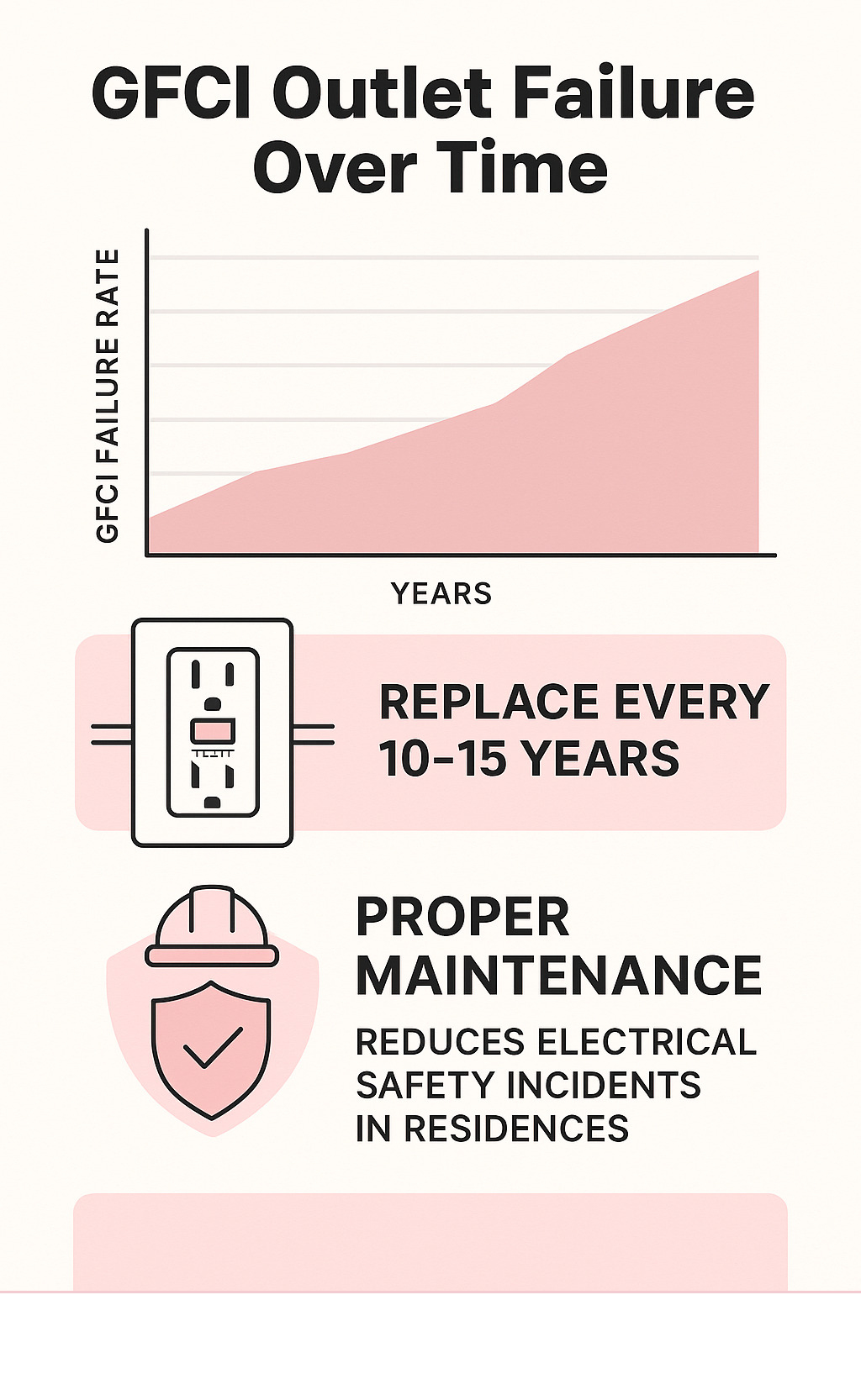
Device failure is inevitable as GFCI outlets age—internal components degrade over time, and the Consumer Product Safety Commission recommends replacement every 10-15 years. Modern GFCI outlets with self-test features may shut down completely when internal protection fails, requiring immediate replacement rather than repairs.
Downstream faults often cause GFCI tripping even when nothing is plugged into the GFCI itself. Water getting into downstream outlets, damaged wire insulation somewhere in the circuit, or faulty appliances can trigger the protection. Professional troubleshooting involves systematically disconnecting downstream circuits to isolate the actual problem.
Insulation resistance testing requires professional equipment to measure wire condition accurately. As wire insulation ages, it allows small amounts of current leakage that eventually trigger GFCI protection.
The 10-year replacement guideline reflects real-world experience with GFCI reliability. While some devices last longer, the stakes are too high to risk protection failure when it comes to your family’s safety.
CPSC statistics demonstrate that locations that require GFCI protection have significantly lower injury rates when proper devices are installed and maintained by professionals.
Why Hiring a Licensed Electrician Makes Sense
Professional expertise extends far beyond basic wire connections. Licensed electricians understand complex code requirements, possess diagnostic equipment for troubleshooting, and carry insurance protection for their work. The expertise gained through years of training and experience cannot be replicated by watching online videos or reading articles.
Diagnostic equipment used by professionals identifies problems that homeowners miss. Insulation resistance testers, ground fault locators, and precision multimeters reveal hidden issues that cause future failures. This equipment investment represents thousands of dollars that individual homeowners cannot justify.
Permit and inspection requirements vary by location, but professional electricians understand local codes and handle required paperwork. In many areas, electrical work requires permits and inspections to ensure safety and code compliance. DIY work often lacks these safeguards.
Warranty protection provides peace of mind that DIY work cannot match. Professional installations typically include warranties on both labor and materials, protecting homeowners from defective devices or installation errors. This protection has real value when electrical problems arise.
At AAA Home Services, we often provide same-day or next-day service for electrical safety upgrades in the Greater St. Louis area. Our 8,000+ Google reviews and 50+ years of experience demonstrate our commitment to customer safety and satisfaction.
The cost of mistakes in electrical work can be catastrophic. Improper installing GFCI outlet work can cause fires, electrocution, or equipment damage that far exceeds professional installation costs. Customer peace of mind comes from knowing the work is done correctly the first time.
For professional electrical services, visit our Electrician Services page to learn more about our comprehensive electrical solutions.
Google Review Spotlight: “Fixed my GFCI in minutes and saved my kitchen!”
One of our recent customers in St. Charles shared their experience with our electrical team: “The GFCI outlet in my kitchen kept tripping every time I used the coffee maker. I thought I needed to replace the outlet, but the AAA electrician diagnosed a loose connection in the electrical box that was causing the problem. He fixed it in minutes and explained exactly what was wrong. Professional, fast, and honest service – exactly what you want when dealing with electrical issues!”
This 5-star review reflects the diagnostic expertise that separates professional service from DIY attempts. What appeared to be a faulty GFCI was actually a wiring problem that could have caused a fire if left unaddressed.
You can read more reviews and learn about our electrical services at AAA Electricians in Saint Charles, MO.
FAQs Homeowners Ask About Installing GFCI Outlet
Why does my brand-new GFCI trip with nothing plugged in?
A new GFCI that trips immediately usually indicates wiring problems rather than device failure. Common causes include reversed LINE and LOAD connections, shared neutral circuits, or existing ground faults in downstream wiring. Professional diagnosis can identify the specific issue and provide appropriate solutions.
Can one GFCI protect multiple outlets downstream?
Yes, a single GFCI can protect multiple standard outlets when wired correctly. The downstream outlets connect to the LOAD terminals of the GFCI, providing protection for the entire circuit branch. This approach is cost-effective and meets code requirements when properly installed.
How often should I schedule professional testing?
While monthly homeowner testing is recommended, professional inspection every 3-5 years ensures optimal performance. Professional testing includes insulation resistance measurements, ground fault simulation, and verification of proper wiring connections that homeowner testing cannot provide.
When Should You Call AAA Home Services?
Several situations require immediate professional attention:
- GFCI outlets that won’t reset or trip constantly
- Outlets that feel warm or show signs of burning
- Sparking or buzzing sounds from electrical outlets
- Homes built before 1975 without GFCI protection
- Kitchen or bathroom renovations requiring code updates
Our electrical team serves St. Charles, O’Fallon, Lake St. Louis, Warrenton, Wentzville, Cottleville, Chesterfield, Ballwin, Ellisville, Town & Country, St. Louis, Maryland Heights, Creve Coeur, Webster Groves, Kirkwood, Clayton, and Brentwood areas with professional electrical services.
Conclusion
When it comes to installing GFCI outlet protection in your home, you’re making one of the smartest electrical safety decisions possible. These life-saving devices have prevented countless electrocutions and fires since their introduction, but their effectiveness depends entirely on proper installation and maintenance.
The truth is, while GFCI outlets might look simple from the outside, the installation process involves critical safety steps that can be dangerous when done incorrectly. LINE and LOAD terminal confusion, improper grounding connections, and electrical box capacity issues are just a few of the technical challenges that separate successful installations from potentially deadly mistakes.
At AAA Home Services, we’ve seen how professional installing GFCI outlet work protects families throughout St. Charles, O’Fallon, and the Greater St. Louis area. Our licensed electricians bring the expertise, specialized equipment, and code knowledge needed to ensure your GFCI outlets provide reliable protection for years to come.
Professional installation offers benefits that DIY work simply cannot match. You get warranty protection on both materials and labor, complete code compliance that passes inspections, and the peace of mind that comes from knowing the job was done right the first time. Our team can often provide same-day or next-day service, so you don’t have to wait weeks for this important safety upgrade.
Remember your monthly testing routine—press the TEST button on each GFCI outlet to make sure it trips, then press RESET to restore power. This simple 30-second check ensures your protection stays active. If any outlet fails to trip or won’t reset, that’s your signal to call our professional team immediately.
With over 8,000 Google reviews and 50+ years of experience, AAA Home Services has built our reputation on fair, honest pricing and award-winning service. We understand that electrical safety isn’t something you want to gamble with, which is why we stand behind every installation with comprehensive warranties and ongoing support.
Code confidence comes naturally when you choose professional installation. Our electricians stay current with National Electrical Code requirements and local regulations, ensuring your home meets all safety standards. This attention to detail becomes especially valuable during home sales or renovations when electrical inspections are required.
For homeowners considering broader electrical upgrades, proper GFCI protection works hand-in-hand with modern electrical panels. Our comprehensive approach to residential electrical safety includes everything from individual outlet upgrades to complete system modernization. Learn more about how we can improve your home’s electrical capacity and safety at our Electrical Panel Upgrades page.
Your family’s safety is worth the investment in professional installation. Contact AAA Home Services today to schedule your GFCI outlet installation and take that crucial step toward comprehensive electrical protection for your home.


