



Understanding the True Cost of AC Repairs
When your home cooling system stops working properly, finding out about ac unit repair cost is likely your first priority. Here’s what you need to know at a glance:
| AC Repair Factor | What to Expect |
|---|---|
| Average Cost Range | Varies by repair type and unit |
| Common Repairs | Capacitor, fan motor, refrigerant leaks |
| Factors Affecting Cost | Unit age, type, warranty status, part availability |
| Service Call Fee | Typically included in repair quote |
| DIY vs Professional | Professional repair recommended for most issues |
When summer temperatures climb in the St. Louis area, a malfunctioning air conditioner quickly becomes more than an inconvenience—it’s an emergency that demands immediate attention. Understanding the potential ac unit repair cost before calling a technician can help you prepare financially and make informed decisions about your cooling system.
Most homeowners face air conditioner repairs at some point, whether it’s a minor fix like a capacitor replacement or something more complex like a refrigerant leak. The repair costs can vary widely depending on several factors, including the age of your system, the type of unit you have, and the specific component that needs attention.
I’m Dan W, with extensive experience managing home repair services and AC technicians across the Greater St. Louis area, I’ve guided countless homeowners through understanding their ac unit repair cost options and making smart decisions about their cooling systems.
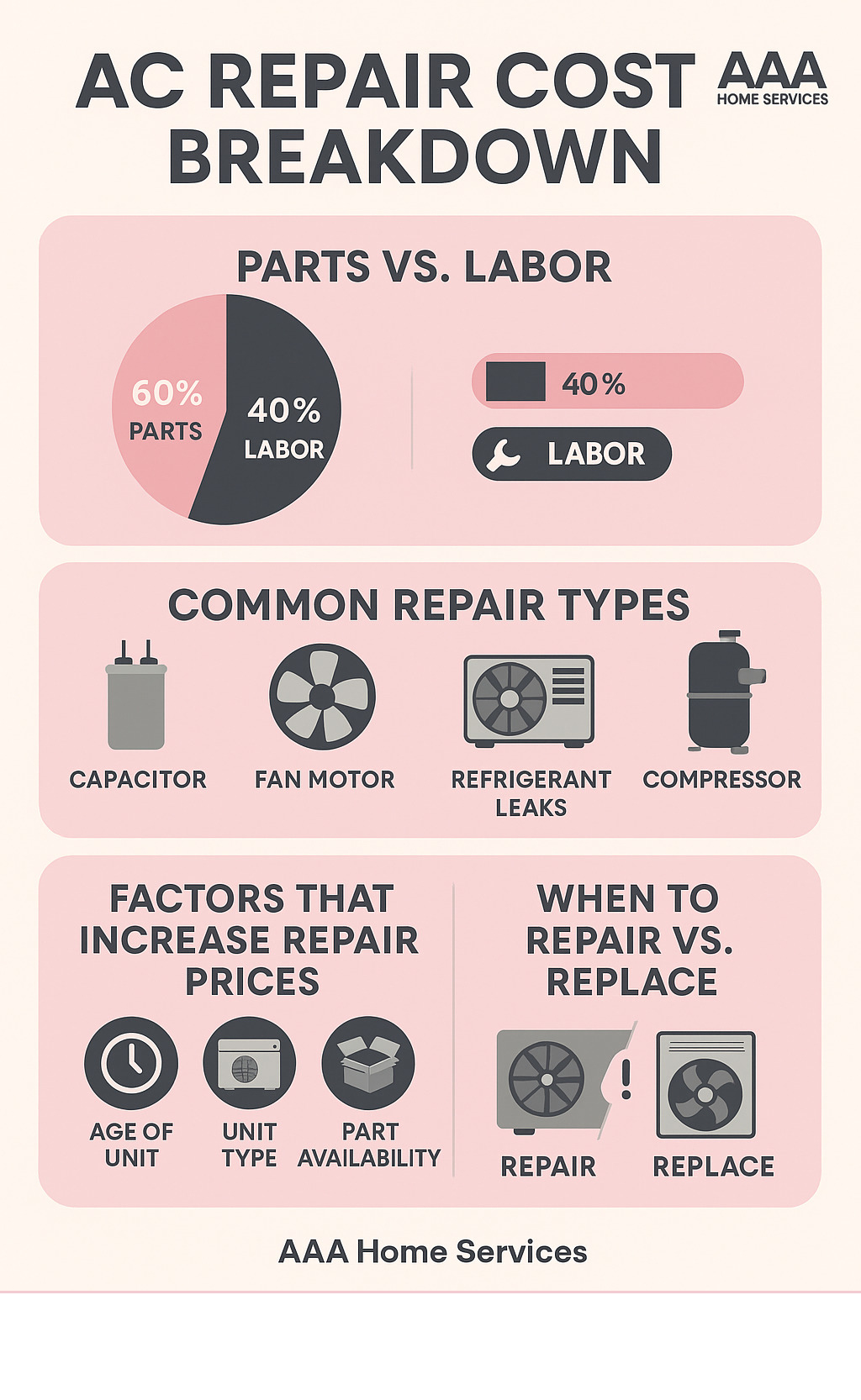
Essential ac unit repair cost terms:
AC Unit Repair Cost: National Averages vs. St. Louis Reality
Wondering what you’ll actually pay to fix your air conditioner? The national average for ac unit repair cost typically falls between $150 and $650 for most standard repairs. But here in the St. Louis area, our unique climate creates a different reality for homeowners.
Our hot, sticky summers and chilly winters mean our cooling systems work overtime compared to those in milder regions. This extra strain can affect both how often repairs are needed and what they’ll cost you when they happen.
When you get that repair bill, you’re really paying for two main things: the parts that need replacing and the skilled labor to install them properly. Here in the Greater St. Louis region, HVAC technician rates reflect the specialized expertise needed to diagnose and fix today’s complex cooling systems correctly the first time.
Most quality HVAC companies in our area (including us at AAA Home Services) build a diagnostic fee into their repair quotes. This covers your technician’s travel time, their thorough system inspection, and the professional recommendations they’ll provide. With our 50+ years serving St. Louis families, we’ve developed pricing that’s straightforward and fair—no surprises or hidden fees.
Your ac unit repair cost also varies significantly depending on what type of cooling system you have:
| AC System Type | Repair Complexity | Common Issues | Typical Repair Range |
|---|---|---|---|
| Central AC | Medium to High | Compressor, fan motors, refrigerant leaks | Varies by component |
| Ductless Mini-Split | Medium | Electronic controls, refrigerant issues | Higher than window units |
| Heat Pump | High | Reversing valve, compressor issues | More complex than standard AC |
| Window Unit | Low to Medium | Fan motors, controls | Lower than other types |
Want to learn more about what might be causing your AC troubles? The Department of Energy offers excellent latest research on AC problems that can help you understand what’s happening with your system.
Breaking Down Your ac unit repair cost Line by Line
When you receive an estimate for AC repairs, understanding each component helps you make smarter decisions:
The diagnostic fee covers your technician’s visit to identify what’s wrong with your system. At AAA Home Services, we’re crystal clear about what this assessment includes and how it benefits you.
Labor costs reflect your technician’s expertise and the complexity of your repair. St. Louis area rates are competitive but fair, considering the specialized knowledge required to work on today’s sophisticated cooling equipment.
Replacement parts vary dramatically in price. A simple capacitor might be relatively affordable, while a compressor replacement represents one of the most significant investments you can make in your existing system.
Most companies include a parts markup that covers their costs for sourcing quality components, maintaining inventory, and handling warranty issues. At AAA Home Services, we pride ourselves on fair pricing for all parts.
Don’t forget about potential warranty credits! If your system or specific components are still under warranty, this can substantially reduce your out-of-pocket costs. Our technicians always check your warranty status before proceeding with any repair work.
Typical Price Range by AC Type
The cooling system you have in your home plays a major role in determining your ac unit repair cost:
Central Air Conditioning Systems are the most common choice for St. Louis homes, offering whole-house cooling through your ductwork. Repair costs vary widely based on which component needs attention—from relatively simple fan issues to more complex compressor or coil repairs. These systems have more intricate components than simpler cooling options.
Ductless Mini-Split Systems typically fall in the middle of the repair cost spectrum. While they’re often less expensive to fix than central air systems, they require technicians with specialized knowledge of their unique components and operation. This expertise can influence labor costs for repairs.
Heat Pump Systems serve double-duty by both cooling and heating your home, which makes them more complex to repair. When components like the reversing valve (which switches between cooling and heating modes) malfunction, you need a technician with specific heat pump expertise—something we pride ourselves on at AAA Home Services.
Window AC Units have the lowest repair costs, but here’s the catch—it’s often more economical to simply replace older window units rather than repair them. For newer or high-quality models, however, repairs can make good financial sense.
Geothermal Systems typically come with higher repair costs due to their sophisticated technology and the specialized knowledge required to service them. The silver lining? They generally need fewer repairs over their lifetime thanks to having fewer moving parts above ground where exposure to the elements can cause wear and tear.
The 7 Factors That Raise or Lower Your Bill
Ever wonder why your neighbor paid less for their AC repair than you did? When it comes to ac unit repair cost, no two situations are exactly alike. The final number on your invoice depends on several key factors that can either inflate or reduce what you’ll pay.
1. Unit Age
Just like that car you’ve had for years, older AC systems generally cost more to repair. Here in St. Louis, where our units work overtime during those humid summer months, age-related wear happens faster than in milder climates.
Systems over 10 years old typically need more frequent repairs as components start wearing out. Once your unit passes the 15-year mark, finding replacement parts becomes challenging – some might even be discontinued, which can significantly increase your ac unit repair cost. Our technicians at AAA Home Services will always give you the straight talk about whether fixing that aging system makes financial sense compared to starting fresh.
2. Size & SEER Rating
Bigger isn’t always better when it comes to repair costs. Larger AC units and those with higher SEER (Seasonal Energy Efficiency Ratio) ratings often come with premium components that cost more to replace. The good news? These higher-efficiency systems typically save you money on energy bills in the long run, which can offset the occasional higher repair expense.
3. Warranty Status
A valid manufacturer’s warranty can be your best friend when facing repairs. Most AC units come with 5-10 year parts warranties, though they typically don’t cover labor costs. If you opted for an extended warranty, you might be covered for both.
At AAA Home Services, we’ll check your warranty status before beginning any work and help steer the sometimes confusing warranty claim process to minimize what comes out of your pocket.
4. Refrigerant Type
The type of refrigerant your system uses can dramatically impact your ac unit repair cost, especially if you’re dealing with a refrigerant leak.
If your older system still uses R-22 (Freon), which was phased out in 2020, expect to pay significantly more than for the current standard R-410A. This price difference isn’t your technician trying to upsell you – it’s simply the reality of limited supply. For more details on this transition, check out the scientific research on refrigerant phase-out from the EPA.
5. Seasonal Demand
In St. Louis, timing is everything. During those sweltering July and August days when everyone’s AC decides to quit at once, technicians are in high demand, which can mean higher labor rates. If you can schedule maintenance during off-peak seasons (fall or spring), you might benefit from more favorable rates and quicker service.
6. Local Labor Rates
Even within the Greater St. Louis area, labor rates can vary. Areas with a higher cost of living, like Chesterfield or Clayton, might have slightly higher service rates than other parts of the region. At AAA Home Services, we maintain fair, consistent pricing throughout our service area.
7. System Accessibility
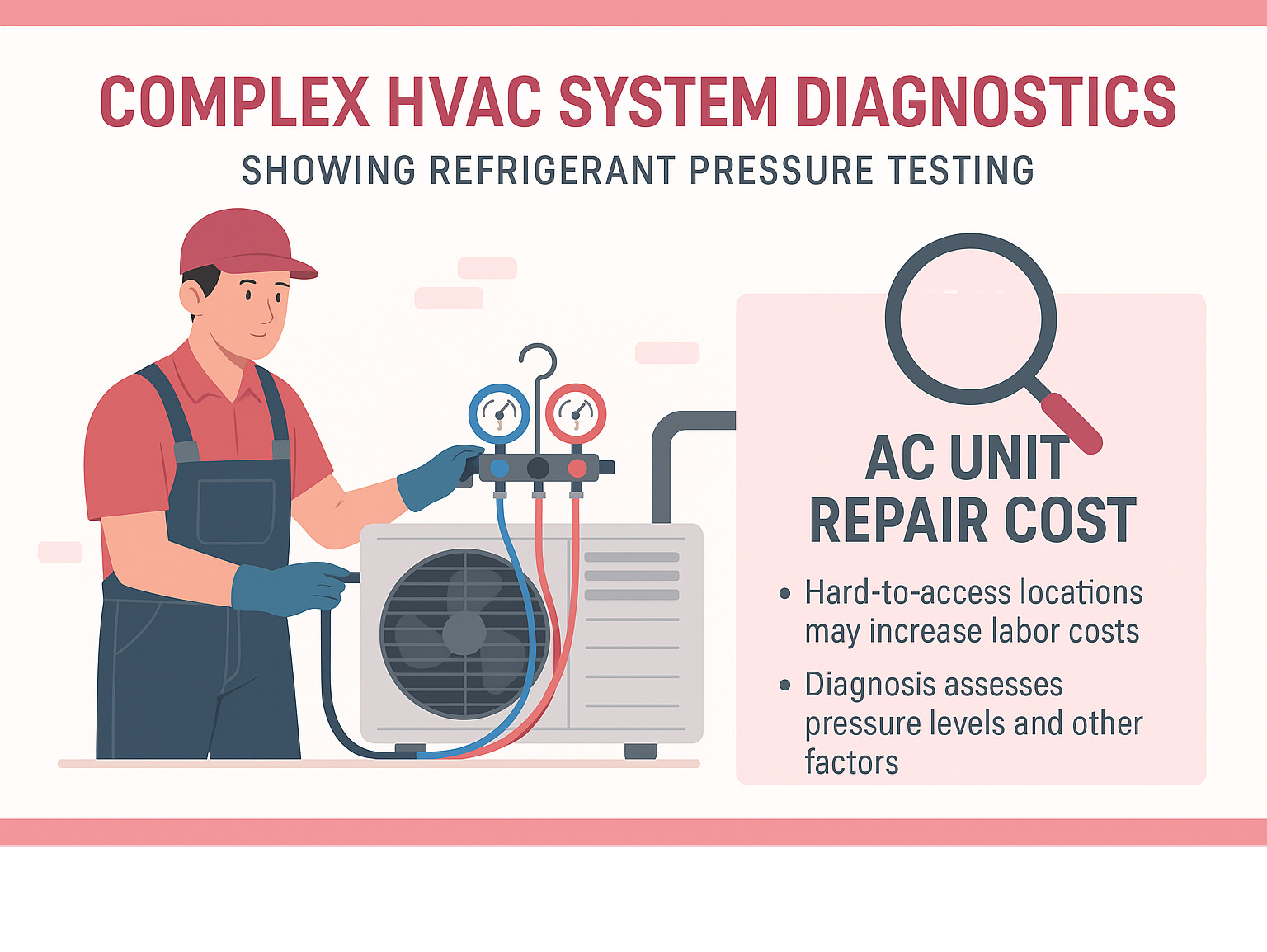
Is your AC unit tucked away in a cramped attic, a tight crawl space, or perched on a rooftop? Difficult-to-reach units require more time and effort to repair, which can increase labor costs. Our technicians have seen it all throughout St. Louis, St. Charles, and Warren County, and are equipped to handle even the most challenging installation locations.

Component Costs You Should Know
Understanding what different parts cost can help you make sense of your repair estimate:
Compressor: This is the heart of your AC system and one of the priciest components to replace. When a compressor fails on an older unit, it’s often time for that “repair vs. replace” conversation – sometimes a new system makes more financial sense.
Capacitor: Think of these as the spark plugs of your AC system. They’re relatively inexpensive and among the most common parts to fail, especially during those brutal St. Louis summers when your system rarely gets a break.
Evaporator or Condenser Coil: These vital coils can be costly to repair or replace. The condenser coil lives in your outdoor unit, exposed to the elements, while the evaporator coil resides inside your home.
Blower Motor: Without this motor, cool air won’t circulate through your home. Replacement costs vary based on your specific system and the type of motor required.
Thermostat: While technically not part of the AC unit itself, thermostat issues can mimic cooling problems. Smart thermostats cost more upfront but can prevent future problems through better system management and save energy dollars in the long run.
Labor vs. Parts: Who Gets the Bigger Slice of Your ac unit repair cost?
When you’re reviewing that repair estimate, you’ll notice it breaks down into two main categories: labor and parts.
Hourly Rates: In the St. Louis region, expect to pay between $75-$150 per hour for HVAC technician labor. This rate reflects the technician’s training, certification level, and expertise. At AAA Home Services, our technicians are highly trained professionals who work efficiently to keep your costs down.
Minimum Charges: Most HVAC companies have minimum service charges that apply even for quick fixes. This covers the technician’s travel time, diagnostic work, and basic service regardless of how simple the repair might be.
Time Requirements: A simple capacitor replacement might take less than an hour, while replacing a compressor could require several hours of careful work. Our technicians work efficiently without cutting corners.
In most cases, labor makes up about 40-60% of your total ac unit repair cost, with parts accounting for the rest. For simple repairs, labor often exceeds parts costs, while major component replacements usually flip that ratio, with parts being the bigger expense.
Repair vs. Replace: The 5,000-Rule Simplified
One of the most challenging decisions homeowners face is whether to repair an existing AC unit or replace it entirely. To help make this decision easier, many HVAC professionals, including our team at AAA Home Services, use the “5,000 Rule” as a guideline.
Here’s how it works: Multiply the age of your equipment (in years) by the repair cost. If the result exceeds $5,000, replacement is likely the more economical option. For example, if your 12-year-old AC needs a $500 repair, the calculation would be 12 × $500 = $6,000, suggesting replacement might be better.
Other factors to consider when deciding between repair and replacement include:
Energy Savings: Newer systems with higher SEER ratings can significantly reduce your energy bills. In the St. Louis area, where summers can be brutally hot and humid, these savings can add up quickly.
Frequency of Breakdowns: If your system has required multiple repairs in recent years, it may be more cost-effective to replace it rather than continue investing in an increasingly unreliable unit.
R-22 Refrigerant Phase-Out: If your system uses R-22 (Freon), which has been phased out, future refrigerant-related repairs will become increasingly expensive. Converting to a newer refrigerant is often not practical or cost-effective.
Financing Options: Many homeowners are surprised to learn that replacing their AC system might be more affordable than they thought, especially with financing options that can spread the cost over time.
For more information about repair services, you can visit our page about Your Go-To AC and Furnace Repair.
When ac unit repair cost Is Still the Smart Money
Despite the guidelines above, there are situations where repair is clearly the better option:
Minor Parts Failures: If your system needs only a simple, inexpensive repair like a capacitor or contactor replacement, and the system is otherwise in good condition, repair is usually the way to go.
Valid Warranty Coverage: If your system is still under warranty, especially a parts warranty, repairs will be much more affordable, making them the more economical choice.
Under-10-Year Systems: Air conditioners typically last 12-15 years. If your system is less than 10 years old and hasn’t had chronic problems, investing in repairs is usually worthwhile.
Single-Component Issues: When only one part has failed and the rest of the system is in good condition, repair is often the most cost-effective solution.
At AAA Home Services, we’ll always provide honest recommendations based on your specific situation, not just pushing for the most expensive option.
When a New Installation Wins
There are clear situations where replacement makes more financial sense than continuing to repair an existing system:
Major Component Failures: If expensive components like the compressor or condenser coil have failed, especially in an older unit, replacement often makes more sense.
Multiple Failures: When multiple components are failing, it’s usually a sign that the entire system is wearing out and more failures are likely to follow.
Outdated Refrigerant: Systems using R-22 refrigerant will face increasingly expensive repairs as this refrigerant becomes scarcer. Converting to a newer refrigerant is rarely cost-effective.
Efficiency Issues: If your system has a low SEER rating (under 13), upgrading to a more efficient system can significantly reduce your energy bills, often helping to offset the cost of replacement over time.
Age Considerations: Systems over 15 years old are nearing the end of their expected lifespan. Even if a repair is possible, the system is likely to have additional failures in the near future.
In the St. Louis area, where we experience both hot, humid summers and cold winters, having a reliable, efficient HVAC system is particularly important for year-round comfort.
Frequently Asked Questions about AC Unit Repair Cost
How much does it cost to recharge refrigerant?
When your air conditioner isn’t cooling properly, refrigerant issues might be the culprit – and many homeowners wonder about this particular ac unit repair cost. Refrigerant recharges tend to be on the pricier side of AC repairs, and for good reason. The refrigerant itself can be expensive, especially if your system uses an older type, and handling it requires specialized equipment and EPA certification.
Here’s something important to understand: your AC doesn’t consume refrigerant like a car uses gas. It circulates in a closed system. So if your system needs a refrigerant recharge, it means you have a leak somewhere. Simply adding more refrigerant without fixing the leak is like filling a leaky bucket – a temporary fix at best.
Our technicians at AAA Home Services are fully EPA-certified to handle refrigerants safely and legally. When we visit your St. Louis home, we don’t just top off your system – we track down those sneaky leaks and repair them properly to prevent recurring problems and unnecessary future expenses.
Does labor usually cost more than the part itself?
The balance between labor and parts in your total ac unit repair cost depends entirely on what’s being fixed. Think of it like car repairs – replacing a headlight bulb might cost more in labor than the bulb itself, while a new transmission will flip that equation.
For smaller AC repairs like replacing a blown capacitor or faulty contactor switch, you’ll typically find labor makes up the larger portion of your bill. These parts are relatively inexpensive, but you’re paying for the technician’s expertise in diagnosing the problem and safely making the repair.
On the flip side, major component replacements tell a different story. When your compressor fails or a coil needs replacing, the parts themselves often represent the bulk of your costs. These sophisticated components are expensive to manufacture and may need to be ordered specifically for your system.
At AAA Home Services, we believe in complete transparency. Our invoices clearly separate labor and parts costs, so you’ll always understand exactly what you’re paying for – no mysterious charges or vague line items.
How often should I schedule professional maintenance to avoid high ac unit repair cost?
The single best way to avoid unexpected and costly AC repairs? Regular professional maintenance. In the St. Louis area, where our systems work overtime during hot, humid summers, we strongly recommend having your air conditioning system professionally serviced at least once per year – ideally in spring before temperatures start climbing.
During these vital maintenance visits, our skilled technicians will:
- Clean or replace air filters (clogged filters force your system to work harder)
- Check refrigerant levels and inspect for potential leaks
- Clean coils and drain lines to prevent efficiency-robbing buildup and water damage
- Test electrical connections and components for safety issues
- Lubricate moving parts to reduce friction and wear
- Verify proper system operation across all functions
This proactive approach pays dividends by extending your system’s lifespan, improving energy efficiency (potentially lowering your utility bills), and catching small issues before they become expensive emergency repairs – especially during those scorching July and August days when your system is working hardest.
Many of our customers throughout Greater St. Louis find our maintenance plans to be particularly valuable. These plans ensure your system gets regular attention from our experienced technicians, often include priority service when issues do arise, and may provide repair discounts that further reduce your ac unit repair cost over time.
Think of maintenance as health checkups for your AC – a small investment that helps prevent major problems down the road. Your air conditioner will thank you with reliable performance when you need it most.
Conclusion
Understanding ac unit repair cost is essential for making informed decisions about your home cooling system. While national averages provide a general guideline, the specific costs you’ll face depend on numerous factors, including your system type, age, the specific repair needed, and local market conditions in the St. Louis area.
Regular maintenance remains the best strategy for minimizing repair costs and extending your system’s lifespan. By catching small issues before they become major problems, you can avoid expensive emergency repairs and keep your system running efficiently for years to come.
When repairs are needed, working with a reputable, experienced company like AAA Home Services ensures you’ll receive honest assessments and fair pricing. With over 50 years of experience serving the Greater St. Louis, St. Charles, and Warren County areas, we’ve built our reputation on providing transparent, high-quality service at reasonable rates.
Whether you need a minor repair or are considering a full system replacement, our team is here to help you steer your options and make the best decision for your home and budget. For more information about our services, visit our Air Conditioning Repair Service page.
The cheapest repair isn’t always the most cost-effective in the long run. Quality parts, proper installation, and expert service from AAA Home Services can save you money over time by reducing the need for repeat repairs and improving your system’s efficiency.
Don’t wait until your AC stops working on the hottest day of the year—schedule a maintenance check today and enjoy worry-free comfort all summer long.


