



Introduction to Your Home’s Heating System
A new furnace installation is a major home improvement that impacts your family’s comfort and energy costs for 15-25 years. A properly installed furnace provides reliable warmth while keeping utility bills in check.
Key factors for a successful installation:
- Timing: Consider replacement when repair costs become significant.
- Type: Choose from gas, electric, oil, or propane based on your home’s needs.
- Sizing: Correct sizing is crucial for comfort and your furnace’s lifespan.
- Efficiency: High-efficiency (90%+ AFUE) models reduce long-term operating costs.
- Installation: Professional work is essential for safety and warranty protection.
Most furnaces last 15-20 years with proper maintenance. Key signs that you may need a replacement include frequent repairs, rising energy bills, uneven heating, or unusual noises. Gas furnaces are the most popular choice for their efficiency and lower operating costs.
The installation process involves removing the old unit, connecting utilities, configuring venting, and thorough testing. Professional installation is often required by law and is necessary to protect your manufacturer warranty.
Why professional installation matters:
- Prevents carbon monoxide leaks
- Ensures proper venting and electrical connections
- Maintains warranty coverage
- Meets local building codes
- Maximizes energy efficiency
I’m Dan Walsh, a home repair service manager. My experience shows that professional installation is the key to a long-lasting, reliable furnace, preventing the need for frequent repairs.
Key Considerations for Your New Furnace Installation
Choosing the right new furnace installation requires understanding your home’s specific needs, from fuel type to proper sizing for peak performance.
When to Repair vs. When to Replace Your Furnace
Deciding whether to repair or replace your furnace can be tough, but clear warning signs can guide your decision.
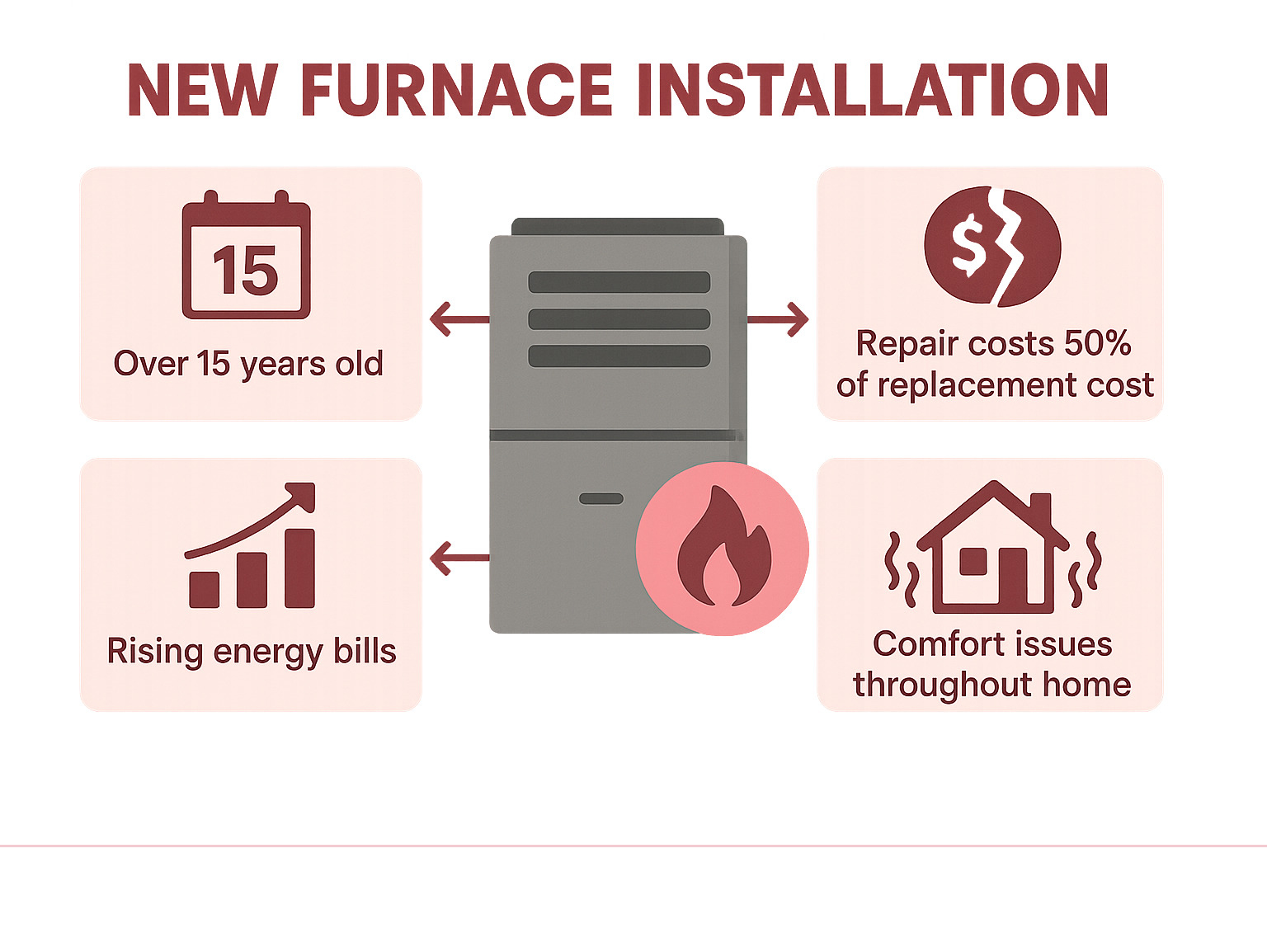
- Age: Furnaces typically last 15-25 years. If your system is over 15 years old and experiencing issues, replacement is a wise consideration.
- Repair Costs: If a single repair costs 50% or more than a new furnace installation, replacement is usually more economical in the long run.
- Rising Energy Bills: A sudden or steady increase in your heating bills without a change in usage often signals that your furnace is losing efficiency.
- Uneven Heating: Hot and cold spots throughout your home indicate your furnace is struggling to distribute air properly, a common issue with aging or incorrectly sized units.
- Strange Noises: Rattling, banging, or screeching sounds often point to failing components that can be expensive to fix.
- Safety Concerns: A cracked heat exchanger can leak deadly carbon monoxide and almost always necessitates immediate replacement. Other red flags include visible rust or a yellow pilot light on a gas furnace (it should be blue).
For more guidance, our team can help you evaluate your options during a Furnace Repair Service visit. You can also read our guide on whether to repair or replace your home appliance.
Choosing the Right Furnace Type and Efficiency
Selecting the right furnace depends on fuel availability, your local climate, and your budget.
| Furnace Type | Fuel Availability | Performance in Cold Climates | Maintenance Needs |
|---|---|---|---|
| Natural Gas | Widely available in urban/suburban areas with gas lines | Excellent, provides very warm heat | Moderate, annual professional check |
| Electric | Universally available (electricity) | Good for milder climates, less effective in very cold | Low, typically outlasts other types |
| Oil | Common in rural or Northeastern areas where oil delivery is prevalent | Excellent, provides very warm heat | High, requires more frequent cleaning due to soot |
| Propane | Available where natural gas isn’t, requires a storage tank | Excellent, similar to natural gas | Moderate, requires tank refills |
Natural gas furnaces are the most popular choice in the St. Louis area. They are economical, efficient, and provide powerful heat. Modern units can achieve AFUE ratings of 90% or higher.
Electric furnaces have lower installation costs and are available anywhere. While operating costs can be higher in cold climates, they are simple to maintain and typically have a longer lifespan.
Oil furnaces are a robust option where natural gas is unavailable. They require an on-site storage tank and more frequent maintenance.
Propane furnaces perform similarly to natural gas units but require a storage tank and scheduled fuel deliveries.
Understanding efficiency is key. AFUE (Annual Fuel Utilization Efficiency) measures how efficiently a furnace converts fuel to heat. A 90% AFUE rating means 90 cents of every dollar spent on fuel heats your home. Upgrading from an older, less efficient model offers significant savings, as explained by The Department of Energy.
We proudly install high-quality, reliable equipment from leading manufacturers, ensuring your investment is built to last.
The Importance of Correct Sizing and Quality Installation
Proper furnace sizing is critical for efficiency, comfort, and the longevity of your system.
Furnaces are sized in BTUs (British Thermal Units). A unit that’s too small will run constantly and wear out, while an oversized one will cycle on and off frequently, wasting energy and creating uneven temperatures.
To avoid guesswork, professionals use a Manual J load calculation to determine the exact size your home needs. This detailed analysis considers factors like square footage, insulation, window types, and local climate to ensure a perfect fit for your new furnace installation.
A properly sized and installed furnace provides consistent comfort, lower energy bills, and a full lifespan of 15-25 years. The quality of the installation is just as important as the brand of the furnace. A skilled, certified technician ensures every connection and calibration is perfect, maximizing efficiency and reliability for years to come.
Protect your investment with our Total Heating & AC System Maintenance services to keep your system running at its best.
The Professional Installation Process and Maximizing Your Investment
A new furnace installation is a significant investment in your home. Choosing a professional ensures years of reliable warmth, lower energy bills, and peace of mind.
What to Expect During a Professional New Furnace Installation
The day of your installation is a planned, professional process. Our technicians respect your home and execute the job with precision.
The process includes:
- Safe Removal: We carefully disconnect and responsibly dispose of your old furnace.
- Site Preparation: We prepare the space to ensure proper airflow and stability for the new unit.
- New Furnace Placement: The new furnace is carefully positioned and leveled.
- Precision Connections: We expertly connect ductwork, gas supply lines, electrical wiring, and condensate drains. For high-efficiency units, this includes installing and sealing PVC venting.
- Rigorous Testing: We conduct thorough tests for gas leaks, proper airflow, and temperature rise, calibrating the system for peak performance.
- Final Walkthrough: After a complete cleanup, we explain your new system’s operation and answer all your questions.
Why Professional Installation is Non-Negotiable
Attempting a DIY furnace installation is extremely dangerous and not recommended. This is a job for trained professionals.
Key reasons to hire a pro:
- Safety: Improper venting can lead to deadly carbon monoxide leaks. Incorrect wiring or gas line connections pose serious fire risks. Our certified technicians handle these connections according to strict safety codes.
- Warranty Protection: Most manufacturers require professional installation to keep the warranty valid. A DIY job will likely void it.
- Code Compliance: Installations are subject to local building codes and permits. A professional contractor ensures your system is compliant and passes inspection.
- Peak Performance: Even the best furnace will underperform if installed incorrectly, leading to higher bills and a shorter lifespan.
Maximizing Your Investment and Choosing a Trusted Partner
When choosing a contractor for your new furnace installation, ask about their experience, licensing, and if they perform a Manual J load calculation for sizing. Ensure the estimate is comprehensive and inquire about warranties on both the unit and labor.
Maximize your savings by pairing your new furnace with proper insulation and a programmable thermostat. Read our guide on How to Save Money on Heating Bills for more tips. Also, ask our team about any available HVAC Rebates & Tax Credits for high-efficiency models.
Regular maintenance is the best way to protect your investment. Annual tune-ups keep your system running efficiently, prevent costly breakdowns, and are often required to maintain the manufacturer’s warranty. Learn more in our guide to Furnace Maintenance for Better Heating & Lower Bills.
For over 50 years, AAA Home Services has provided expert new furnace installation across Greater St. Louis, St. Charles, and Warren County. We are committed to fair, honest service. As one customer noted on our AAA Home Services in O’Fallon, MO Google page, our technicians are “very professional and did a great job.” This reflects our dedication to quality workmanship.
We understand a new furnace is a significant purchase, which is why we offer convenient Financing Options for Home Services to fit your budget.
Ready for the comfort and efficiency of a professionally installed new furnace? We can often provide Same Day or Next Day service. Schedule your Best New Furnace Installation with us today.


